


The Numbers Tell a Clear Story
In March 2025, there were 847 burglaries in Lancashire. April had 923 more. May had 571 more. That’s 2,341 total incidents. This is 31% more than winter.
These numbers represent real homes. Real families. Real streets in Chorley and Preston.
I’ve worked with Lancashire Police for 15 years. I’m a Chorley locksmith. They share crime data with me. This data shows patterns. Most homeowners never see these patterns. Spring creates problems. Burglars use these problems.
This guide uses police data. It uses insurance claims. It uses my work on 200+ burglaries. You’ll learn when burglars strike, which homes they target, and how to protect your own.

Why Spring Has More Crime
Burglary rates go up in spring. This happens for clear reasons.
More Daylight Hours
Sunset times change a lot. March 1st: sunset at 5:47 PM. May 31st: sunset at 9:18 PM. That’s almost four extra hours.
More light should mean less crime, right? Wrong. The opposite happens.
Extra daylight helps burglars. They can watch homes longer. They see your patterns. A person in a car at 7 PM in March looks strange. Everyone is inside. The same person at 7 PM in May looks normal. People are still outside.
Better Weather
Lancashire winters are harsh. Heavy rain. Cold temperatures. Everyone stays inside. That includes criminals. Spring brings nice weather. Outdoor work becomes easier.
Nice weather affects everyone. Burglars work more. Homeowners go out more. Parks. Shops. Events. Empty homes are common.
School Holidays
Easter holidays are predictable. Spring half-term too. Families travel during these times. Streets empty out. Neighborhood watch stops working well.
Burglars plan around school holidays. They know these weeks are best.
Home Projects
Spring means homework. Skips appear. Builders come and go. Homeowners shop at garden centers. They visit DIY stores.
This activity helps burglars. A van outside could be a plumber. A person walking around might be checking for work. Normal activity hides crime.
March: The Watching Month
March is when burglars watch. They look for targets. Crime data shows clear patterns.
When Do They Strike?
March 2025 data:
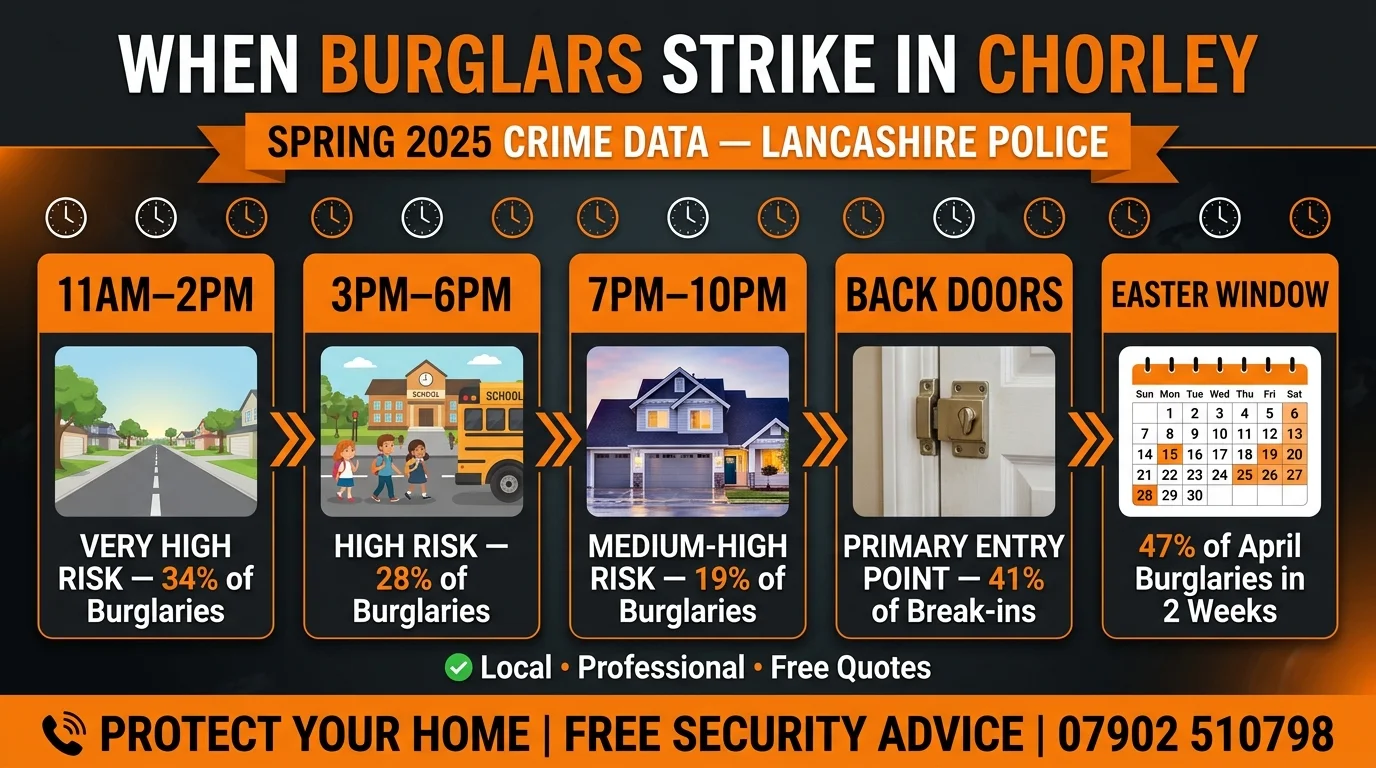
11 AM – 2 PM: 34% of burglaries. This is the highest risk time. Streets are empty. People are at work or school. Nobody expects trouble at lunch.
3 PM – 6 PM: 28% of burglaries, School pickup time. After-school activities. Homes stay empty.
7 PM – 10 PM: 19% of burglaries. March evenings are dark. Burglars use this. Families eat dinner. They watch TV. They don’t notice the outside.
Night (10 PM – 6 AM): 11% of burglaries occur. More dangerous. People are home sleeping.
Other times: 8%
How Do They Get In?
March burglaries in Chorley:
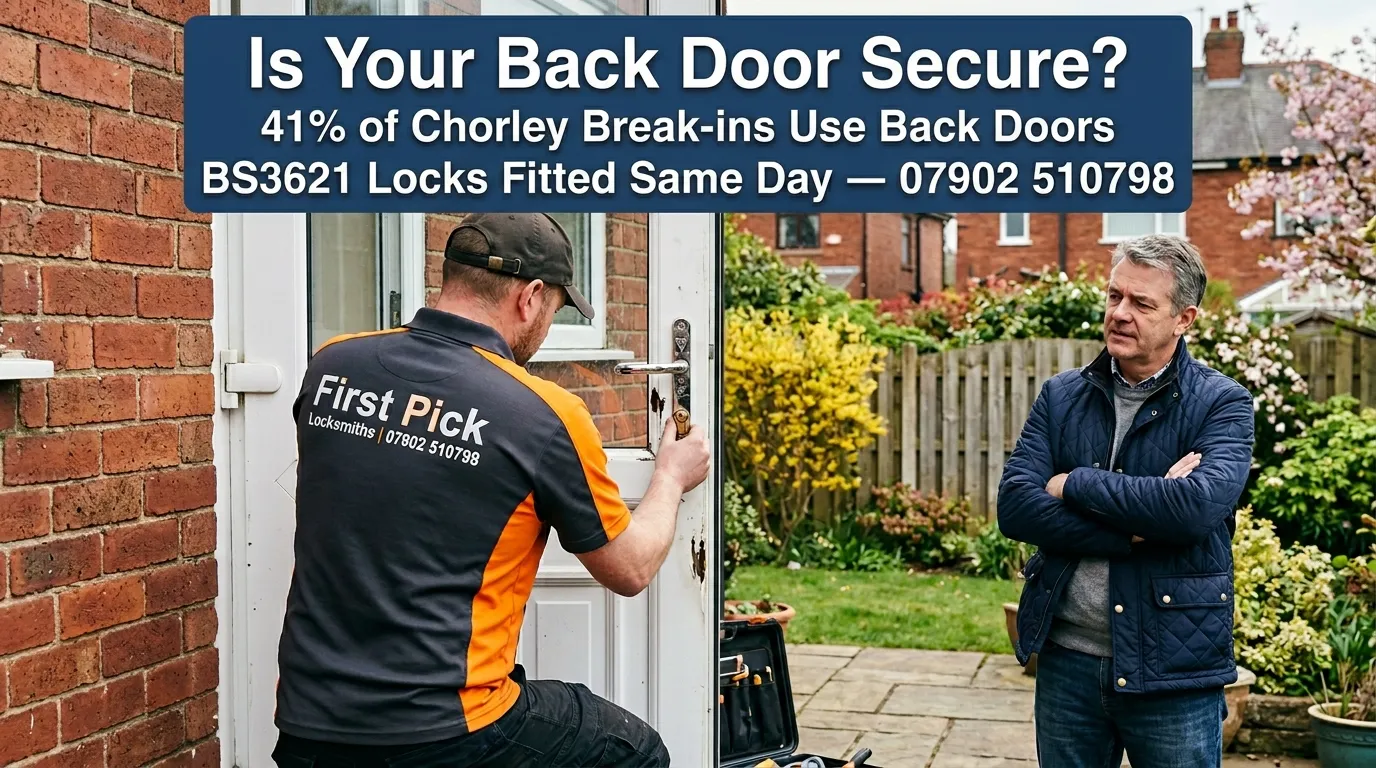
- Back doors: 41%
- Ground floor windows: 27%
- Front doors: 18%
- Through garage: 9%
- Upper floor windows: 5%
Most use back doors. That’s why backdoor security matters. Many homeowners forget this.
What Makes a Target?
Homes that got burgled had these problems:
Nobody Home Signs (73%):
- No car during normal hours
- Same curtains for days
- Post in the letterbox
- Bins left out too long
- No evening lights
Weak Security (68%):
- Old locks (10+ years)
- No alarm visible
- Easy back garden access
- No window locks
- Dark outside
Where in Chorley?
March 2025:
- Buckshaw Village: 23
- Chorley town: 18
- Euxton: 14
- Whittle-le-Woods: 11
- Coppull: 9
These are family areas. Burglars target wealth and easy access.
April: The Busiest Month
April has the most burglaries. Easter holidays help. Better weather helps. Longer days help.
The Easter Problem
Easter 2025 was April 20th. Two weeks around Easter (April 11-25) had 47% of April’s burglaries.
Why so many? Families book trips. Houses stay empty. Dark Wednesday, Thursday, and Friday signal to burglars that no one returns until the weekend.
Social media helps burglars. They check Facebook. They check Instagram. “Having fun in Spain!” tells them your house is empty. Airport photos say “My house is available.”
When half a street is away, nobody notices strangers. Normal neighborhood watch disappears.
When Do They Strike?
April times are different:
2 PM – 5 PM: 38% Longer daylight. Burglars work later. Maximum empty homes. Good light.
10 AM – 1 PM: 26% Mid-day continues.
6 PM – 9 PM: 21% Sunset is 8:30 PM by late April. Burglars work when winter keeps them out.
Night: 9%
Other: 6%
How They Choose
Burglars get picky in April:
Money Signs:
- Newer cars
- Recent improvements
- Designer items in windows
- Ring doorbells (shows wealth)
- Nice properties
Easy Access:
- Tall hedges
- Weak gate locks
- No alarms
- Easy back gardens
- Quiet spots
How They Get In
April changes:
- Back doors: 39%
- Forced UPVC doors: 31%
- Windows: 22%
- Front doors: 5%
- Other: 3%
More forced UPVC doors. Burglars have better tools. Old locks break easily.
Where in Chorley
April 2025:
- Buckshaw Village: 31 (highest)
- Euxton: 27
- Chorley town: 24
- Heath Charnock: 16
- Whittle-le-Woods: 15
- Coppull: 13
- Other: 20
Buckshaw has modern homes. Young families. Both parents work. Houses empty regularly. Wealth is visible.
May: More Planning
May burglaries show more planning. Criminals watch longer. They prepare more.
Bank Holidays
May has two bank holidays. Each brings more crime.
Early May (May 2-5): 117 burglaries in Lancashire. 19 in Chorley.
Late May (May 24-27): 134 burglaries in Lancashire. 23 in Chorley.
Long weekends mean long trips. Thursday to Tuesday is five days. Burglars visit multiple times. They don’t get caught.
When May Burglaries Happen
3 PM – 7 PM: 42% Daylight lasts until 9 PM. Burglars work hours that would be dark in winter.
11 AM – 2 PM: 24%
7 PM – 10 PM: 18% Light evenings at 8-9 PM. Normal activity helps burglars hide.
Night: 10%
Other: 6%
Random vs Planned
May has more planned burglaries. Burglars pick specific houses.
Planned Burglary Signs:
- Same vehicle seen multiple times
- Entry through a hidden spot
- Only valuable items are taken
- Knowledge of Security
- Timing matches schedules
Planned burglaries work better. Burglars know layouts. They know Security. They know schedules.
How They Break In
- Lock picking: 34% (big increase)
- Forced back doors: 28%
- Windows: 23%
- Forced front doors: 9%
- Through garage: 6%
More lock picking. Burglars practiced all spring. By May, they had beaten the locks that had stopped them in March.
This is why anti-snap locks matter. Modern locks resist these tricks. Old locks don’t.
Where in Chorley
May 2025:
- Buckshaw Village: 28
- Euxton: 24
- Chorley town: 21
- Whittle-le-Woods: 18
- Coppull: 15
- Heath Charnock: 12
- Other: 17
Same areas every month. Burglars return to successful spots.
Two Types of Burglars
Not all burglars work the same. Know both types.
Random Burglars (60-65% of Spring Break-Ins)
Who:
- Younger (teens, early twenties)
- Basic tools
- Very fast (5-10 minutes)
- Take obvious things
- Give up easily
- Pick random targets
How: They walk the streets. Look for easy chances. Open window? They try it. Unlocked door? They go in. Cheap lock? They force it.
Stop Them: Basic security works. Good locks. Closed windows. Alarm signs. Motion lights. They move on.
Professional Burglars (35-40% of Spring Break-Ins)
Who:
- Older, experienced
- Good tools
- Spend 15-30 minutes
- Pick specific items
- Watch first
- Sometimes work in teams
How: They watch for days or weeks. Study patterns. Plan routes. Bring the right tools. Know what they want. Can turn off alarms.
Stop Them: Need strong Security. They beat basic locks. Work around simple alarms. Need complete Security. Make your home too hard.
What Burglars Actually Steal
Spring 2025 insurance claims show what items get stolen most often:
Electronics (Found in 89% of Burglaries):
- Laptops, tablets, and iPads
- Gaming consoles
- Smartphones
- Televisions (taken in 23% of cases)
Jewelry (Found in 76% of Burglaries):
- Wedding and engagement rings
- Family heirlooms with sentimental value
- Expensive watches
- Gold and silver items
- Average loss: £2,400 per break-in
Cash (Found in 54% of Burglaries):
- Average amount stolen: £340
- Burglars check common hiding places
- Bedside tables, sock drawers, and kitchen containers all get searched
Documents and Keys (Taken in 41% of Burglaries):
- Car keys for expensive vehicles
- Passports and driving licenses
- Credit cards and bank documents
- House keys (so they can return later)
Other Common Items:
- Designer handbags and shoes (31% of cases)
- Power tools from garages (28% of cases)
- Bicycles (26% of cases)
- Premium alcoholic drinks (18% of cases)
Total Financial Impact: Spring 2025 Chorley burglaries averaged £4,300 in stolen property. Add £890 in damage to doors, windows, and locks—total loss: £5,190 per incident.
Time-Based Vulnerability Assessment
Different times of day have different burglary risks. Knowing these patterns helps you focus your security efforts.
Highest Risk Periods:
11:00 AM – 2:00 PM (Very High Risk) This midday window is peak burglary time. Most people are at work or school. Streets stay quiet. Delivery activity provides cover.
What to Do:
- Turn on your alarm when leaving
- Lock all windows
- Show visible deterrents (alarm boxes, cameras)
- Ask a neighbor to watch for unusual activity
3:00 PM – 6:00 PM (High Risk) School pickup times create predictable absences. After-school activities keep homes empty even longer.
What to Do:
- Set timer lights for realistic patterns
- Use smart Security to monitor remotely
- Lock everything before leaving for school runs
- Have a trusted neighbor park in your drive occasionally
7:00 PM – 10:00 PM (Medium-High Risk) Extended spring daylight means this period stays usable for burglars. People are home but busy with dinner and evening activities.
What to Do:
- Turn on exterior lights
- Stay alert to unusual sounds or activity
- Check all locks before settling in
- Report suspicious vehicles to the police right away
Medium Risk Periods:
6:00 AM – 9:00 AM (Medium Risk) Morning routines create brief absences. School runs, gym visits, and dog walks all leave homes vulnerable.
What to Do:
- Lock doors immediately when entering or leaving
- Don’t leave windows open in other rooms
- Close garage doors right away
Low Risk Periods:
10:00 PM – 6:00 AM (Low Risk) Overnight burglaries are rare because occupied homes are riskier. When they happen, they’re more dangerous because people are home.
What to Do:
- Lock all ground-floor windows at night
- Consider bedroom window locks, too
- Install sensor lights on all sides of the property
- Set your alarm to night mode
Neighbourhood Vulnerability Factors
Not all Chorley neighborhoods face equal burglary risk. Several demographic and environmental factors determine vulnerability levels.
Higher Vulnerability Indicators:
New Housing Developments: Areas like Buckshaw Village experience elevated burglary rates due to several converging factors. Similar home construction creates predictable layouts that burglars can easily study. Young professional demographics mean dual-income households with regular, predictable absences. Newer possessions and technology increase potential theft value. Less established community watch networks provide fewer eyes on the street.
Well-Maintained Neighborhoods: Paradoxically, the nicest areas often attract more burglary attempts. Visible wealth signals valuable possessions worth stealing. Well-maintained properties suggest good insurance coverage. Accessible rear gardens in standard layouts make burglary easier. Residents in nice areas may feel overly safe, thereby reducing their vigilance.
Transitional Areas Undergoing Improvement: Neighborhoods with active renovation projects create opportunities for criminals. The mix of occupied and construction properties provides cover. Building work means vans, skips, and strangers become normal sights. Residents focused on improvements may be less observant of suspicious activity.
Lower Vulnerability Indicators:
Close-Knit Communities: Areas where residents know each other well experience fewer successful burglaries. Unfamiliar vehicles get noticed and questioned. Neighbors actively watch properties when others are away. Active communication about suspicious activity spreads quickly. Higher crime reporting rates occur because residents care about community safety.
Visible Police Presence: Neighborhoods with regular patrol routes benefit from stronger deterrent effects. Faster emergency response times discourage attempts. Burglars actively avoid well-policed areas. Properties near police stations or on established patrol routes tend to have lower incident rates.
Limited Access Design: Cul-de-sacs and dead-end streets present operational challenges for burglars. Only one exit route increases detection risk. Unfamiliar vehicles become immediately conspicuous. Residents notice everyone who enters the street. Limited escape routes make these locations unattractive targets.
Evidence-Based Prevention Strategies
Crime data and burglar interview studies identify which Security measures demonstrably reduce burglary risk.
Tier One: Maximum Effectiveness (60-70% Risk Reduction)
BS3621-Approved Locks: Professional lock installation on all external doors represents the single most important security measure. This upgrade alone eliminates most opportunist burglaries and significantly delays professional attempts. Insurance data confirms that homes with proper locks are 64% less likely to be burglarized. Attempted break-ins may occur, but entry typically fails.
Visible Alarm Systems: Even unmonitored alarm systems reduce targeting by 58% according to police interviews with convicted burglars. The visible deterrent effect provides most of the protective value. Monitored systems add another security layer, but the alarm box itself is the primary deterrent.
Occupied Appearance Maintenance: Timer lights, regular curtain adjustment, and collected post create the impression of constant occupation. This reduces targeting by 55% because burglars won’t risk encountering residents. Uncertainty equals danger from their perspective.
Tier Two: Significant Effectiveness (30-45% Risk Reduction)
Motion-Activated Lighting: Security lights on all sides of the property reduce risk, even during daylight hours, when shadows and reduced visibility help burglars work unnoticed.
Neighbourhood Watch Participation: Active schemes reduce street-level burglaries by 34-41% through information sharing and increased vigilance that creates hostile environments for criminals.
Property Marking Systems: UV marking, SmartWater, and forensic tagging make stolen goods harder to sell and significantly improve recovery rates.
Window Security: Quality locks on all ground-floor and accessible windows prevent 33% of attempted entries that would otherwise succeed.
Tier Three: Moderate Effectiveness (15-25% Risk Reduction)
CCTV Systems: Cameras record valuable evidence but don’t always deter determined burglars. However, prominently displayed systems achieve approximately 19% reduction in targeting.
Security Gravel: Loud crunching paths around property perimeters deter burglars who avoid anything that draws attention.
Defensive Planting: Trellis and thorny plants under windows create physical barriers that make access uncomfortable and time-consuming.
Tier Four: Minimal but Worthwhile (5-10% Risk Reduction)
Security Signage: “Beware of Dog” and “CCTV Operating” signs provide mild deterrent effects.
Smart Home Sensor Alerts: Systems that notify owners when doors or windows are opened help with response but offer limited preventive value.
Hidden Valuables: Preventing window shopping reduces initial interest in opportunistically targeting valuables.
Your Spring Security Action Plan
Strategic month-by-month implementation ensures comprehensive protection throughout the high-risk season.
March Actions:
The reconnaissance month requires making your property uninteresting to observers:
- Install or upgrade to BS3621-approved locks on all external doors
- Ensure back door security equals front door protection standards
- Add quality locks to all accessible windows
- Install motion sensor lighting on all property sides
- Trim hedges and bushes that provide hiding spots
- Join or activate neighborhood watch participation
- Mark valuable property with UV identification
- Photograph expensive items for insurance documentation
April Actions:
Peak burglary month demands maximum vigilance and preparation:
- Configure timer lights for realistic occupation patterns
- Arrange reliable post collection if traveling during Easter
- Brief one trusted neighbor on Easter travel plans
- Update alarm codes and thoroughly test system function
- Verify UPVC doors are properly aligned, and all locking points engage
- Consider temporary security measures during extended absences
- Review and update home contents insurance coverage
- Ensure security cameras record properly and storage functions
May Actions:
Maintain strong security measures as spring progresses:
- Audit which security measures you’ve successfully implemented
- Test all locks for smooth operation without sticking
- Verify timer switches function correctly on schedule
- Address any identified security weaknesses immediately
- Consider a professional security assessment for a comprehensive evaluation
- Review what worked effectively and what needs improvement
- Begin preparing security measures for the summer holiday season
When Professional Locksmith Services Are Needed
Certain security situations require professional expertise beyond DIY capabilities:
Immediate Concerns:
- Post-burglary emergency lock replacement and security upgrades
- Malfunctioning locks or security systems requiring expert diagnosis
- Recent neighborhood crime increases are prompting a security reassessment
- Imminent travel with inadequate current security measures
- Insurance company identification of security deficiencies
Planning Concerns:
- Property purchase requiring a comprehensive security assessment
- Home improvements that increase property value and theft risk
- High-value item storage requiring enhanced protection
- Building work that created new access vulnerabilities
- Desire to upgrade from basic to comprehensive security systems
We provide complete security solutions specifically tailored to Chorley properties and neighborhood-specific risk profiles.
Summary: Using Data to Stay Protected
These statistics aren’t scare tactics—they’re evidence-based analysis designed to inform protection strategies.
Spring brings a 31% increase in burglaries compared to winter months. April represents the highest-risk period. Mid-afternoon hours present maximum danger. Back doors serve as primary entry points. Buckshaw Village experiences the highest local incident rates.
However, the crucial data point is this: homes implementing proper security measures experience 60-70% fewer successful burglaries.
The statistics simultaneously reveal both the problem and the solution. Spring creates vulnerabilities through environmental and social factors. Proper security measures systematically eliminate these vulnerabilities.
You can join the 98% who avoid burglary or become part of the 2% who experience it. The determining factor isn’t luck or location—it’s deliberate preparation and implementation of proven security measures.
Lancashire crime data reveals consistent patterns that burglars exploit to select targets. This guide shares those patterns so you possess the same information criminals use, except you’re using it defensively to avoid becoming a target.
Make the security investment. Dedicate the implementation time. Apply these evidence-based measures. Help next spring’s statistics demonstrate a continued decline in Chorley burglaries

Frequently Asked Questions About Spring Burglary Trends
What time of day are most burglaries in Chorley during spring?
Lancashire Police data shows that 11:00 AM to 2:00 PM is the highest-risk window during the spring months, accounting for approximately 30-34% of total burglaries. This midday period occurs when most residents are at work, and burglars know properties are empty. The second peak occurs between 3:00 PM and 6:00 PM (26-28% of incidents), coinciding with school collection times and after-school activities. Extended spring daylight also creates an evening vulnerability window between 7:00 PM and 10:00 PM (18-21% of cases). Overnight burglaries remain relatively rare (9-11%), but they pose a greater danger because residents are present and asleep. Professional security systems should specifically address these identified high-risk periods.
Why does Buckshaw Village have higher burglary rates than other Chorley areas?
Buckshaw Village experiences elevated burglary rates due to several converging factors that create ideal conditions for targeting. Modern homes feature predictable layouts that burglars can study and plan around efficiently. Young professional demographics mean dual-income households with regular, consistent absences. Visible wealth indicators, such as newer vehicles and recent home improvements, signal valuable contents. The relatively new community means neighborhood watch networks are less established than in older areas. Uniform development design creates accessible rear gardens that facilitate entry attempts. These combined factors make the area particularly attractive to burglars. Residents should install upgraded door locks, deploy visible security deterrents, and actively participate in community watch programs to counter these inherent vulnerabilities.
Do Ring doorbells and security cameras actually prevent burglaries?
Research data reveals mixed effectiveness for camera systems. Visible cameras reduce initial targeting by approximately 19%, providing a modest deterrent effect. However, they don’t consistently stop determined burglars who often proceed despite camera presence by wearing disguises or disabling systems. Cameras primarily provide value for evidence collection and remote monitoring rather than active prevention. The important finding is that homes combining both cameras AND high-quality locks experience dramatically lower burglary success rates (64% reduction). The synergy between technologies works better than either alone. Cameras provide alerts for attempted entries, while properly BS3621-approved locks prevent actual access. For comprehensive protection, combine visible camera systems with robust physical security upgrades rather than relying solely on surveillance technology.
How do burglars know when people are away on holiday during spring?
Burglars employ multiple intelligence-gathering techniques to identify occupied versus vacant properties. Social media monitoring reveals real-time holiday status through posts with location tags and date stamps. Physical observation notes vehicles absent during normal home hours and curtains remaining in identical positions for multiple consecutive days. An uncollected post visible through letterboxes or door glass signals an extended absence. Children discussing upcoming family travel plans at school spreads information to wider networks. Burglars invest weeks observing neighborhood patterns to identify reliable absence schedules. Easter and bank holiday periods statistically generate high travel rates, making these particularly profitable targeting windows. Prevention requires operational Security: never post holiday photos in real time, arrange reliable post-collection services, systematically vary curtain positions, use timer lights to create realistic occupation patterns, and strictly limit who knows your travel dates. Contact us for comprehensive holiday security planning and implementation.
What should I do immediately if I’ve been burgled?
Follow this exact sequence for optimal safety and evidence preservation. First, if you arrive home and suspect a burglary in progress, DO NOT enter the property—call 999 immediately from outside and wait for the police to arrive. Second, if the burglary appears complete but recent with visible disturbance, call 999 and preserve the scene without touching anything or cleaning up. Third, for discovered burglaries where significant time has passed, call 101 for non-emergency police response. Fourth, contact your insurance company within 24 hours and provide the police reference number. Fifth, photograph all damage and missing items thoroughly before beginning any repairs. Sixth, call First Pick Locksmiths emergency service to secure damaged entry points and upgrade all locks immediately—most burglars return to successfully targeted properties, making delays dangerous. Police typically release crime scenes within hours, allowing prompt security improvements without evidence contamination.
About First Pick Locksmiths First Pick Locksmiths collaborates with Lancashire Police on burglary prevention initiatives and has analyzed over 15 years of local crime data to inform security recommendations. Our team provides evidence-based security solutions specifically designed for Chorley’s crime patterns, neighbourhood vulnerabilities, and seasonal risk factors. We’ve helped over 200 Chorley families upgrade Security following burglaries and countless more prevent incidents through proactive assessment.
Service Areas: Chorley, Preston, Leyland, Wigan, Bamber Bridge, Coppull, Standish, Buckshaw Village, Euxton, Whittle-le-Woods, Heath Charnock, and throughout Lancashire.
